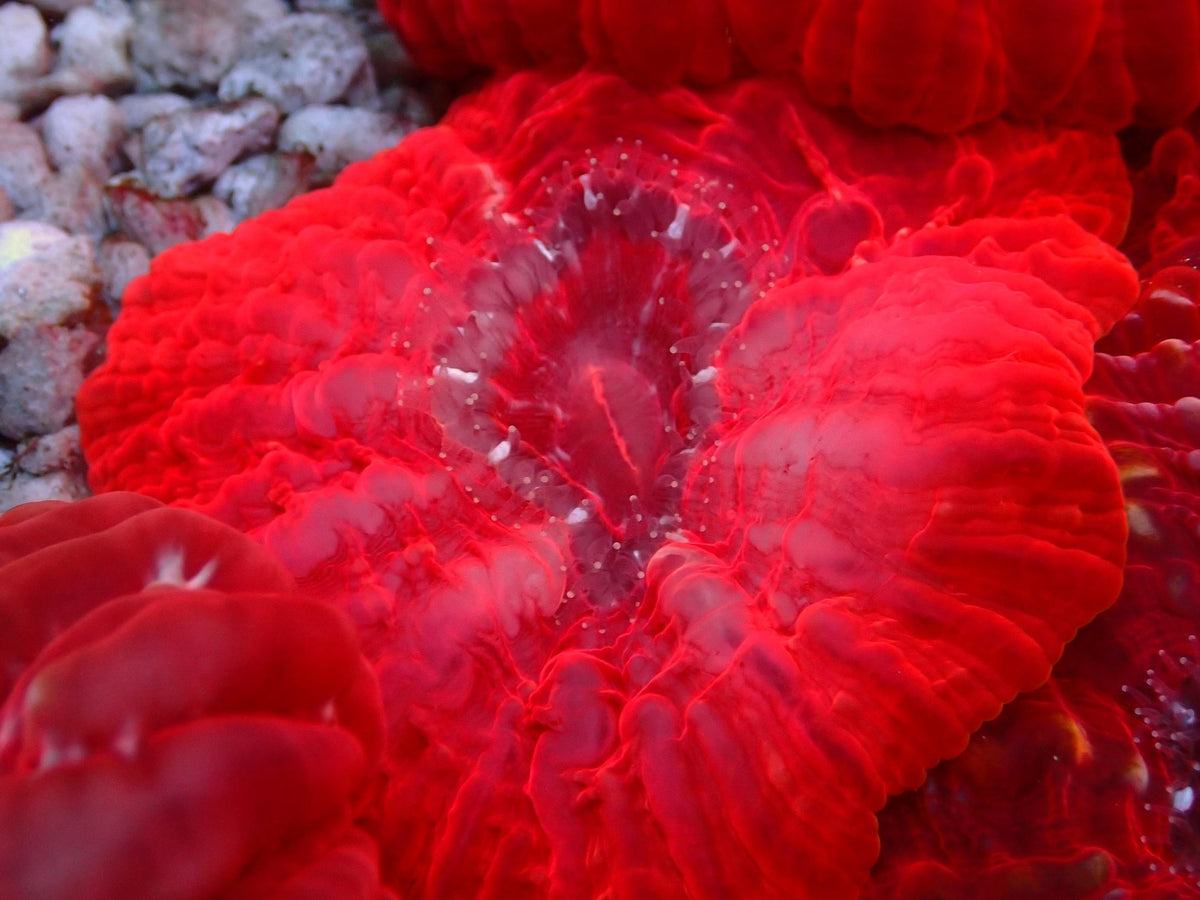
Cynarina – WYSIWYG. You get exactly the coral shown in the photo.
Blue-light photo with white balance Size: WYSIWYG
At a glance
Species: Cynarina lacrymalis – sold as “Ultra Red”
Colour: bright red, translucent tissue with white tentacle tips
Growth form: single polyp with large, fleshy tissue bubbles
Group: LPS coral (large-polyp stony coral)
Size: WYSIWYG
About this coral
Cynarina lacrymalis is a single-polyp coral with large, fleshy tissue bubbles that inflate during the day. “Ultra Red” is a trade name for especially intense red specimens. The photo is a blue-light photo.
Care
Placement: on the sand bed
Light: low to medium
Flow: low so the tissue can fully extend
Spacing: leave some room, it extends sweeper tentacles at night
Yes. WYSIWYG means you receive exactly the specimen in the photo.
Are these the real colours?
The photo was taken under blue light with white balance. Under different lighting the colours may look different.
How do I place the coral?
Start a little lower or in a shadier spot, then move it to full light gradually over one to two weeks.
Acanthophyllia & Cynarina · Solitary LPS polyp
Care at a glance
Typical requirements of the genus – individual specimens may differ.
Difficulty
Easy to moderate (Cynarina), moderate (Scolymia).
Light
Low to moderate; too much light makes the tissue shrink.
Flow
Low, so the polyp can inflate fully.
Placement
On the sand bed, not wedged between rocks.
Feeding
Feed mysis or krill directly onto the mouth once or twice a week.
Acanthophyllia, Cynarina, Scolymia and Indophyllia are large solitary corals that live as a single, plump polyp. During the day they inflate into a glowing dome whose colours range from neon green to deep red. Cynarina is considered long-lived and fairly uncomplicated, while Scolymia is a little more demanding. Both do best when placed on the substrate and fed regularly. Gentle flow prevents detritus from settling on the tissue. Over time they grow noticeably and become a calm centrepiece of your reef.
Choosing a selection results in a full page refresh.
Opens in a new window.
PayPal Pay Later Messaging
Step 1: Choose message placement
Click the button below and then hover over your page to select a placement.
Step 2: Paste and save
You have copied the placement for the Product Page.
Go back to the App Embeds section, and in the Paypal Advanced Settings, paste the copied value into the
Product Page field and click the 'Save' button in the top right corner.